Logo

Logo

Wednesday, February 4, 2015

E-Man: Appreciation and Inspiration

by Darren Goodhart

This all started while I was working on a new drawing featuring the character Liberty Belle. As most Charlton fans know, Liberty Belle made her first appearance in the back pages of E-Man (#5 to be exact) in her one-and-only appearance (so far) by writer Joe Gill and artist Steve Ditko. As I was working on the piece, it got me to thinking about all of the characters that appeared in the pages of E-Man, which led me to thinking about a “dream” project that I think most Charlton fans would’ve loved to see back in the day: an E-Man annual that would feature all of the characters who had appeared in the book.

Before I get too far ahead though, I have to admit, I was sort of a latecomer to Charlton Comics when I was a kid. My brother wasn’t and I distinctly remember him getting copies of Charlton’s Hee-Haw comic, the Partridge Family book, the Bugaloos comic, and George Wildman’s incredible work on Charlton’s run on Popeye. I, of course, was looking over those books and in particular loved Wildman’s Popeye (even eventually teaching myself to draw Popeye by copying Wildman’s work), but still I always hesitated buying anything from them for a couple of reasons; 1) I was pretty much concentrating on DC and Marvel comics, and 2) my Dad put a limit on how many comics I could buy in a week: two.
 
One week though, I was in the grocery store where I regularly bought my comics, and there wasn’t really anything that was particularly appealing to me from the Big Two and I saw a couple of these E-Man comics from Charlton (#6 and #9). I flipped through the books and though the art was a little more cartoony than what I was used to, I thought “What the heck…” and picked them up.

Well, I absolutely loved them!  E-Man and his girlfriend Nova Kane were really cool and friendly characters and the stories by writer Nicola Cuti were just a lot of fun. I really started to love Joe Staton’s artwork the more I kept looking at it and I was just absolutely enchanted. On top of all of that, both issues featured back-up stories with this odd robot cab driver called Rog-2000, written by the aforementioned Mr. Cuti and drawn by another artist I had never heard of, John Byrne. Again, I was just enchanted as could be.

Now, I was always drawing when I was a kid and I started off by copying pictures out of comics in pencil on some really cheap paper that my Dad used to bring me. By the time I’d picked up these copies of E-Man, I started to use a black Flair pen to ink my drawings and I was going further and coloring them with colored pencils. I started to create my own comics and one of the very first things I ever did was a little 9-page E-Man story with E-Man (flying solo) in a rematch with the Brain/Genius villain (sorry, the character’s name escapes me) from E-Man #9. I was in the habit of starting a comics story and never really finishing it, but this one was different. I was just excited drawing this thing and I went on and actually completed it (and I wish like crazy that I still had it; I’d certainly show it if I did).

Eventually, I managed to find more issues of E-Man over time, though some of them still escaped me. I didn’t discover the back-ups featuring The Knight, Travis, and Liberty Belle until just a few years ago, thanks to the Diversions of the Groovy Kind blog. I look back now at that time in Charlton and comics history and there really wasn’t anything like E-Man out there from anyone. Oh sure, you certainly had super-hero comics, but nothing like the tongue-in-cheek adventures of E-Man and Nova, and yet those stories also contained some great thrilling parts and some real poignant moments. The back-up stories were always trying something new and you think of the range of stories--the gritty adventure of super-agent Link Chain, The Knight, the light fantasy of the time-traveler Travis, broad super-heroics with the star-spangled Liberty Belle, the even broader adventures of Steve Ditko’s silent crime fighter Killjoy, and the wacky situations faced by Rog-2000 faced...this was fun stuff!

As I’ve gotten older, I find more inspiration from that original run of E-Man. There was a real go-for-broke attitude with that title and while it might seem quaint in comparison to the world-shattering, constantly character re-defining moments that we see in comics today, I don’t think that’s a bad thing at all. In fact, I think it’s just the thing we need a little more in our comics today.

Consider this a huge salute to Joe Staton, Nicola Cuti, John Byrne, Steve Ditko, Joe Gill, Tom Sutton, and Wayne Howard for the terrific work they provided on that original run. This inspired me at the age of 13 and it’s still inspiring me today at the age of 52...and I’d bet that I’m not the only one.
© Darren Goodhart

Thursday, January 29, 2015

Steve Ditko's Static at Charlton


By Von Grimm

Like many long time comic fans, I fell in love with the medium at a young age. I learned to read from comics. Comics have been a lifetime passion of mine. One of the artists responsible for this passion was one of Charlton's (and indeed the entire industry's) shining stars, the legendary Steve Ditko. 

I first discovered Ditko's work in reprints: The Origins of Marvel Comics collection, as well as Marvel Tales, which reprinted Ditko's Spider-Man run from the beginning. Even at a young age, Ditko's work spoke to me more than most of the current books being published.

Then one day, while pouring through the spinner rack at the local K&B drugstore, I came across something that I thought was called Static, but on closer inspection, it was Charlton Action Featuring Static! What was this?

I flipped through the comic, instantly recognizing that oh so familiar art style. New Ditko! My ten year old mind boggled! I had to have it! Thus, this became my first Charlton.

I had seen some Charltons before. Some of the funny animal and war reprint books that were then on the stands. Strange books, these Charltons, with their old fashioned but cool artwork and their cheap paper. The company was in their last gasp, not that my ten year old self knew anything about that at the time.

But this was Ditko! All Ditko!

In classic comic hero fashion, Stac Rae undergoes a scientific experiment which allows him to manipulate the electrical energy of the space environment suit that he and his friend, Dr. Serch, have been working on.

Stac and Co. are soon drawn into a murder scene as Dr. Serch's colleagues are being killed off by "The Armed Man." I really liked the AM design, a classic Ditko motif that would have been at home in Spider-Man, Blue Beetle, or a number of other Ditko strips. (In fact, thinking about it, it's pretty similar to Iron Arms from Captain Atom. Hmm...!)

The second tale, Pet Monster, seems a pretty standard take on the "Creature on the loose" genre, until the last page. The half splash reveal seemed grotesque to me back then, although it's truly tame by modern standards (and those of the time, most likely).

But it's the third story which is my favorite of this trio. “The Beginning” relates the tale of Captain Brak, a space cop who becomes merged with a living universe (eat your heart out, Grant Morrison!) to become a hero. This is a story in the mold of Ditko's own Shade and the Levitz/Ditko Starman and I wish there were more of it. It remains to this day one of my favorite Ditko stories. Pure imagination unleashed! *

Along the bottom of the first few pages of “The Beginning” are examples of other concepts Ditko was working on. I eagerly scanned across all these "new" characters wondering at the story and names behind each of them. Some of them I've learned about: Mr. A, Killjoy, Missing Man. Most remain a mystery to me. Mysteries I hope to solve one day.

I long ago lost my original copy of CA #11, but thanks to my friend, Steven Butler, and the good people at www.mycomicshop.com I have replaced it and picked up many other great Charltons.

Not too long ago, I received 2oww1! and severalother Snyder-Ditko comics. New Ditko! My on-the-verge-of-turning-forty-years-old mind boggles...

Oh, and then I discovered Dr. Graves. But that's a story for another time. 
© Von Grimm

* Ditko’s Static was retitled, recolored, relettered and slightly rewritten from its original 1983 debut in Eclipse Monthly, from which Ditko pulled the serial following editorial disagreements.

Monday, January 12, 2015

Writer In Progress 5: Tales of the Red Pen


By Derek Adnams

And thus we arrive at the last, and what has become my favorite, part of my personal writing process–the Re-Write.  Or, as I call it:

The Red Pen Edit

When I began this series in November, I opened with a great quote from Kurt Vonnegut about the two kinds of writers: “Swoopers” and “Bashers”...

This seems to be an appropriate place to begin discussing the re-write process. I’m a “Swooper,” even when writing the script, based on a carefully planned outline and detailed story. Sitting at the computer with my notebook (see above) in front of me, the script just sort of pours out. I know it’s a first draft, so any inconsistencies and mediocrities will be ironed out with the Red Pen Edit.

Once the draft is done and I break the ramblings into pages, I print the whole thing out. Some pages will be fully realized script, and those I will look over for grammatical and formatting mistakes, ways to improve dialogue, and to ensure that the scene accomplishes what it is intended to do in the best and most efficient way possible.

Then there are the pages that only include some vague panel descriptions or a snippet of “cool” dialogue. Those get almost totally rewritten, or, in some most cases, written for the first time, with the aforementioned red pen. I like the tactile experience of using a pen, and it gets me into a different mind space than the one I’m in while typing. 

And red brings back all sorts of wonderful memories of High School English papers!

Once the Red Pen Edit is complete, I give it a day to percolate a little bit, then read through my notes and scribbling, making sure everything makes some sort of sense. Then it’s back to the computer to type everything out, another form or a re-write as panel descriptions and dialogue can often change and be enhanced at this stage as well.

Once it’s all said and done, or written and done, the script will have gone through five stages:

1. Story – A brainstorm of all the ideas you want to include in the comic book, realized in some sort of narrative framework

2. Structure – Taking that story and working it into The Three Act Structure and The Hero’s Journey

3. Break-Down – Taking your structured story and molding it into the format of a comic book, paying close attention to page turns and reveals, as well as giving your artistic collaborator room to create

4. Script – Where you turn pictures in your head into words on a page, which will then turn into pictures in an artist’s head and then assemble themselves on a different page

5. Re-Write – Throwing away about 80% of what you just did and making it better!

Now you’re ready to submit your masterpiece to the good people at Charlton Neo!

The End

Further Reading (or, Books That Make Me Seem Kinda’ Smart)

Words for Pictures: The Art and Business of Writing Comics and Graphic Novels by Brian Michael Bendis


Saturday, January 3, 2015

Love in Bloom


By Paul Kupperberg

There’s nothing quite like the moment when contributors copies of the hot off the press newest project you’ve worked on arrive at your door. The box or package is opened and out spill copies of the work, all brand new and shiny. Often, this is the first time I’ve seen the finished story or book. Just the other day, the surprise in the package were copies of Archie Loves Betty and Veronica Mad Libs, a project I wrote over a year ago. And just as good as finally getting to see the finished piece was the fact that the book carries my byline. Mad Libs do not, as a rule, run writer’s credit. Instead, the cover and title page usually just read “Concept created by Roger Price & Leonard Stern,” but at the insistence of the licensor, my pals and gals at Archie Comics, I was given the rare Mad Libs title page byline.

Not that my name hasn’t been on enough publications that one more or less was going to make a difference. It’s appeared in plenty of credit boxes, book and comic book covers, tables of content, title pages, and in footnotes and endnotes of comics history and reference books.

Anyway, a couple of days after the arrival of the Mad Libs, Mort Todd sent me a PDF of the first issue of an upcoming Neo title for proofreading that elevated my name to a place it had never been. That I never expected it to wind up. Not just above the title...but actually a part of the title. As in Paul Kupperberg’s Secret Romances. Like “Alfred Hitchcock Presents” or “Stan Lee Presents”...only, you know, not.

While it’s definitely a massage to the ego having your name in the title, it’s also a little embarrassing. And, in the case of Paul Kupperberg’s Secret Romances, not my idea. My working title for the project had been Postmodern Love Stories, which was how I pitched it--beginning in 2011, pre-Charlton Neo--to whatever comic book publishers I could reach out to. Those that bothered to respond praised the material but passed on the book because, as they all said, “romance comics don’t sell.” Of course they don’t; you can’t sell what isn’t being published.

But logic being what it is to those who have already made up their minds, Postmodern Love Stories made the rounds, after which it kind of just lay there, not forgotten but going nowhere. Until mid-2014, when it suddenly became apparent to me that I finally had access to an editor who might be open to my proposal: me!

Well, Charlton Neo, to be exact. I pitched Postmodern Love, Neo said yes, and my orphaned project finally had a home. The ideal home. The original Charlton Comics had been a prolific publisher of romance titles and, like the other genres that modern mainstream comics has seen fit to ignore in favor of all-superheroes, all the time, Charlton Neo believes in comics without capes to add flavor to the otherwise homogenous stew of bulging biceps and colorful costumes.

It was Mort’s idea that we change the title to connect the comic to its Classic Charlton roots. I ran the list of Charlton romance titles and Secret Romance seemed to be the best fit. Mort also thought it would be a good idea to add my name to the title, purely, as I recall, as a marketing move. We were having these discussions mid-year, during the height of the media attention I was receiving for having written “The Death of Archie,” so exploiting my name seemed to make sense at the time, I suppose. Whatever...it got me a comic book with my name in the title.

And, no, the title doesn’t mean that these are tales of my own romances, secret or otherwise (well, with the exception of an incident that ended up being used as a springboard for one of the stories), just good old fashioned love stories with a nod towards 21st century realities. And snark. A lot of snark. I mean, have you met me?!

It’s not out of line, nor without some poetic symmetry, to say that getting Secret Romances to publication has been a labor of love, and wouldn’t have been possible without the aid and abetment of a whole lot of talented and generous people, beginning with artists Pat and Tim Kennedy, who penciled three stories for the proposal, and scrivener  extraordinaire Jack Morelli who lettered two of the above. But I’ll go into more depth on the ladies and gentlemen who brought my scripts to reality in the next go-round on this here blog.

Paul Kupperberg's Secret Romances #1
by Paul Kupperberg, Pat and Tim Kennedy, P.D. Angel Gabriele, Daerick Gross Sr., Rob Kelly, Jeff Austin, Bob Smith, Jack Morelli, Matt Webb, and Mort Todd.
Cover by Jose Luis Garcia-Lopez
Available February 1, 2015...receive your copy by Valentine's Day!
http://morttodd.com/secrom1.html

"Happily Ever After" Ain't What it Used to Be!
© Paul Kupperberg

Saturday, December 20, 2014

Anatomy of a Neo Story-Part 4


By Paul Kupperberg

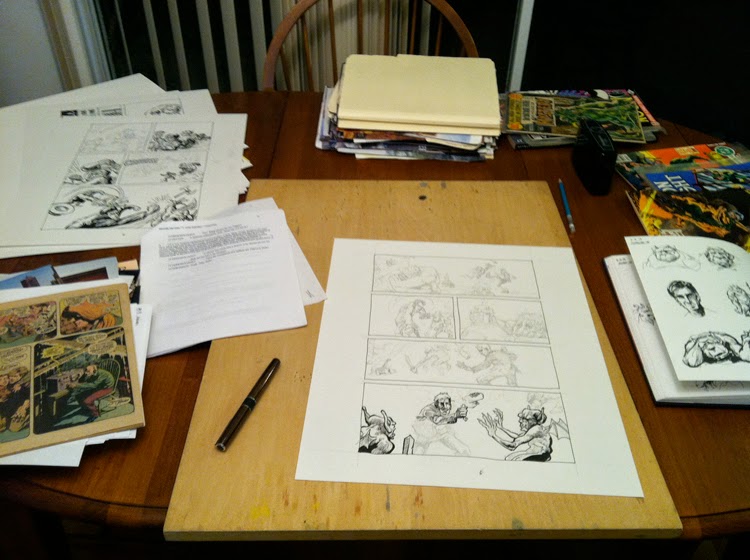
Portrait of the artist's workspace while drawing "Digger" Graves
Ideas are a dime a dozen.

I get ideas for stories, characters, scenes, bits, whatever, all day long. I get them while I’m working on other projects, while I’m driving, while I’m making dinner, while I’m watching TV, while I’m in the shower. My mind is always working, always processing my thoughts in that mysterious way that turns random electrical pulses in the brain into a story or a creative concept. I couldn’t shut it off even if I wanted, which, of course, I don’t. Ideas are my job, my bread and butter.

I have probably twenty or thirty of them a day...although, truthfully, most of them turn out not to be very good . Execution of a good idea is hard enough; execution of a bad one is downright painful. The young, inexperienced writer thinks all their ideas are gold; the experienced ones, in the words of Kenny Rogers, “knows when to hold ‘em and knows when to fold ‘em.”

With about a thousand comic book stories under my belt and almost two decades behind an editor’s desk, I’ve developed a pretty good sense of what will work and what won’t. Sure, it’s easier to separate the wheat from the chaff when it comes to other writer’s ideas, but once I get past the initial “Eureka!” thrill moment of the birth of any idea, I can usually spot it for the dog it is.

Likewise, I know a good one when it comes my way. The way you know if an idea has any legs is that when you sit down to develop it, it will almost (as we say) “write itself.” Characters come to life, you can hear their “voices” in your head, and situations and stories suggest themselves almost as fast as you can write them down.

So it was with Digger Graves, Paranormal P.I. As I recounted in an earlier post, the bare bones concept--“Son of Dr. Graves, supernatural investigator”--popped into my head during a Facebook Messenger chat with Roger McKenzie, and came to life in a subsequent work session that lead straight into the first script, “’I’ of the Beholder!” which was handed off to artist Andrew Mitchell to bring to life.

And, man, did he ever! The East Village of Digger’s reality is a world full of the demonic, the damned, and the dead, and Andy captured the casually weird and spooky ambience I had pictured in my mind’s eye while I was writing the script. Last time around, I posted Andy’s preliminary sketch for the first page of the story, re-presented here for the sake of comparison...

...With the near-finished art...

...Which is followed by final art, with Mort Todd’s lettering laid in...

...And, the fabulous finished page, colored by the talented Matt Webb...
And there you have it...how an idea makes its way from a spark to a comic book story. But this isn't the end of "Digger" Graves. The next story has already sparked in my brain, just waiting for me to get it on paper so we can start the whole process over again.

© Paul Kupperberg / Art © Andrew Mitchell

Tuesday, December 16, 2014

Writer In progress 4: The Script Is The Thing

By Derek Adnams

Ah – the script! Where most novice writers immediately begin before doing all the frontend work discussed in the last three posts. 

And that’s fine, because, at least for me, it’s the most enjoyable step of writing a comic book! 

With all the “structure” previously discussed, one would think that the script itself would adhere to a rigid format. Well, it doesn’t! Unlike the screenplay and the story or novel, which needs to have a set format to even be looked at by a publisher, the comic book script has no such thing! Of course, there are aspects all comic book scripts need, like page and panel numbers, panel descriptions and dialogue, but it can be formatted any way you want!

When looking for a format that works, there are a ton of resources available today, like The Comics Experience Comic Book Script Archive.

I use a mash-up of the formats Scott Snyder and Jonathan Hickman employ on their scripts, all of which were available in the back of various hardcover collections.

The script is really a letter to your artistic collaborator, telling them how you envision the story so they can take those written words and interpret them through their own prism into what will eventually be shared with the world. That being said, there are two common ways to write a script: Marvel Method and Full Script.

Marvel Method is when a basic plot with a few details is given to the artist and they go on to interpret it any way they feel works best. The writer then goes back and retrofits the dialogue into what the artist has drawn. I tend to do this with prolonged action scenes. Unless there are specific motifs or details that need to occur, I will five the artist instructions along these lines: “Pages 14 – 16: have the characters fight, just make sure Character A gets hit on the head and is lying unconscious in the last panel of Page 16.” 

For non-action scenes, I write Full Script. This is similar to a screenplay in which everything is spelled out, literally, for the artist. Full script is how most modern comic books are written, and it does serve as the best representation of the writer’s intent. I like writing full script, mainly because that is how I have always written comic books, even when my buddy Brandon Bullock and I were making comics on copier paper back in high school. It leaves no question in the artists mind as to what is going on and allows the writer to include little details, imagery, and motif in case you want to get all literary and stuff.

Another common issue when writing a comic book script is whether to write the action first or the dialogue. Again, there’s no real set method, so what I do depends on the focus of the scene or “beat.” If it’s a “talking heads” scene, I’ll write the dialogue then break it into panels, taking the page count and the page turn and reveal breakdown into consideration. If it’s action, and it needs to happen a specific way so I’m actually scripting what transpires, I’ll write each panel out, then break it into pages, then add any dialogue, if necessary. I’m not a proponent of dialogue during fight scenes, unless it can add subtext to what is transpiring, or one of the characters is Spider-Man.

A few rules I have acquired over the years have made my relationships with artistic collaborator much better. The first is to script no more than 5 or 6 panels per page. This gives the artist plenty of room to show-off and add panels if they feel a different approach will improve the visual flow. I stole this from Jonathan Hickman. 

The second rule-of-thumb I employ regards word count. You don’t want so much dialogue that the balloons cover the art, so, according to 2000 A.D.’s submission guidelines; you want no more than 25 words per balloon or caption, with a maximum of three balloons or captions per panel. This may seem draconian, but honestly, once I incorporated this into my writing, it made the editing and rewriting phase much easier.

And that’s where we’ll pick-up next time!

Next Week – The Red Pen Edit

Further Reading (or, Books That Make Me Seem Kinda’ Smart)

Making Comics: Storytelling Secrets of Comics, Manga and Graphic Novels by Scott McCloud
Comics and Sequential Art: Principals and Practices of the Legendary Cartoonist by Will Eisner
Graphic Storytelling and Visual Narrative by Will Eisner
 
 © Derek Adnams

Saturday, December 6, 2014

Writer In Progress 3: Breaking It Down


By Derek Adnams

I am a self-confessed structure junkie. That’s not a secret, and now that I have my story all worked out and I’ve made sure it fits into both The Three Act Structure and The Hero’s Journey (see the previous installment of “Writer in Progress”), I can further satisfy my craving by constructing the actual comic book I’m writing by Breaking It All Down For A Four-Color World.

The first step is to look at the story and decide which format best suits what I’m looking to accomplish. Is this a 22 page one shot? A graphic novel?A 6-pager for the good people at Charlton Neo? Or have I written my Sandman-esque Magnum Opus? If you’re a beginner like me, you’re probably looking at nothing longer than a four issue mini-series. 

For our purposes here, let’s assume I have a 22 page one-shot on my hands. Once I know for sure how long the project will be, I break the story into “beats” or “scenes,” a.k.a. the major actions that take place in the story. It’s always a good idea to either open with action or a unique visual image, and to start the narrative as late into the story as possible without ruining the integrity of the tale. No one wants to read about the hero going to the grocery store...unless, of course, that’s the story you’re writing.

Trey Parker and Matt Stone, the creators of South Park, have a great technique they use when working out story beats. In a speech they delivered at NYU (I think), they said that they make sure that between each beat they can say either “therefore” or “but.” For example: this happens therefore this happens but this happens therefore this happens but.... You see where this is going. I find this very useful in making sure the story has the necessary twists and turns to keep a reader’s attention and isn’t a boring linear list of events.

Once the major beats have been worked out, the next step is deciding how many pages each beat will need to properly convey the story. Remember, people buy comic books for the visual aspect, so no matter how catchy your dialogue is, the audience for a 22 page talking head book is not very abundant. I try to keep consecutive talking head pages to no more than two at a time, breaking them up with some sort of prolonged visual action or effect.

Probably the most useful piece of advice I received when I was beginning to seriously write came from Alan Moore’s Writing for Comics. In it he stated that he would write the numbers 1 through 22 down the side of a piece of paper, then detail what takes place on each page, being sure to remember that odd-numbered pages are page turns and even numbered pages are reveals.

I’ll repeat: odd-numbered pages are page turns and even numbered pages are reveals.

What this means is that you want your cliff-hanger story points to occur on odd-numbered pages, and then have the resolutions to those cliff-hangers or the introduction of a new character happen on an even-numbered page.

Now that I know what will happen on each page of the comic book, and the story beats are worked out, the action scenes, as well as the page-turns and reveals, you get to the fun part!

Next Week – The Script

Further Reading (or, Books That Make Me Seem Kinda’ Smart)
Alan Moore’s Writing for Comics by Alan Moore

Understanding Comics: The Invisible Art by Scott McCloud

© Derek Adnams